MATSim User Meeting 2026
September 28, 2026 CICSU, Pierre et Marie Curie campus of Sorbonne University, Paris, France
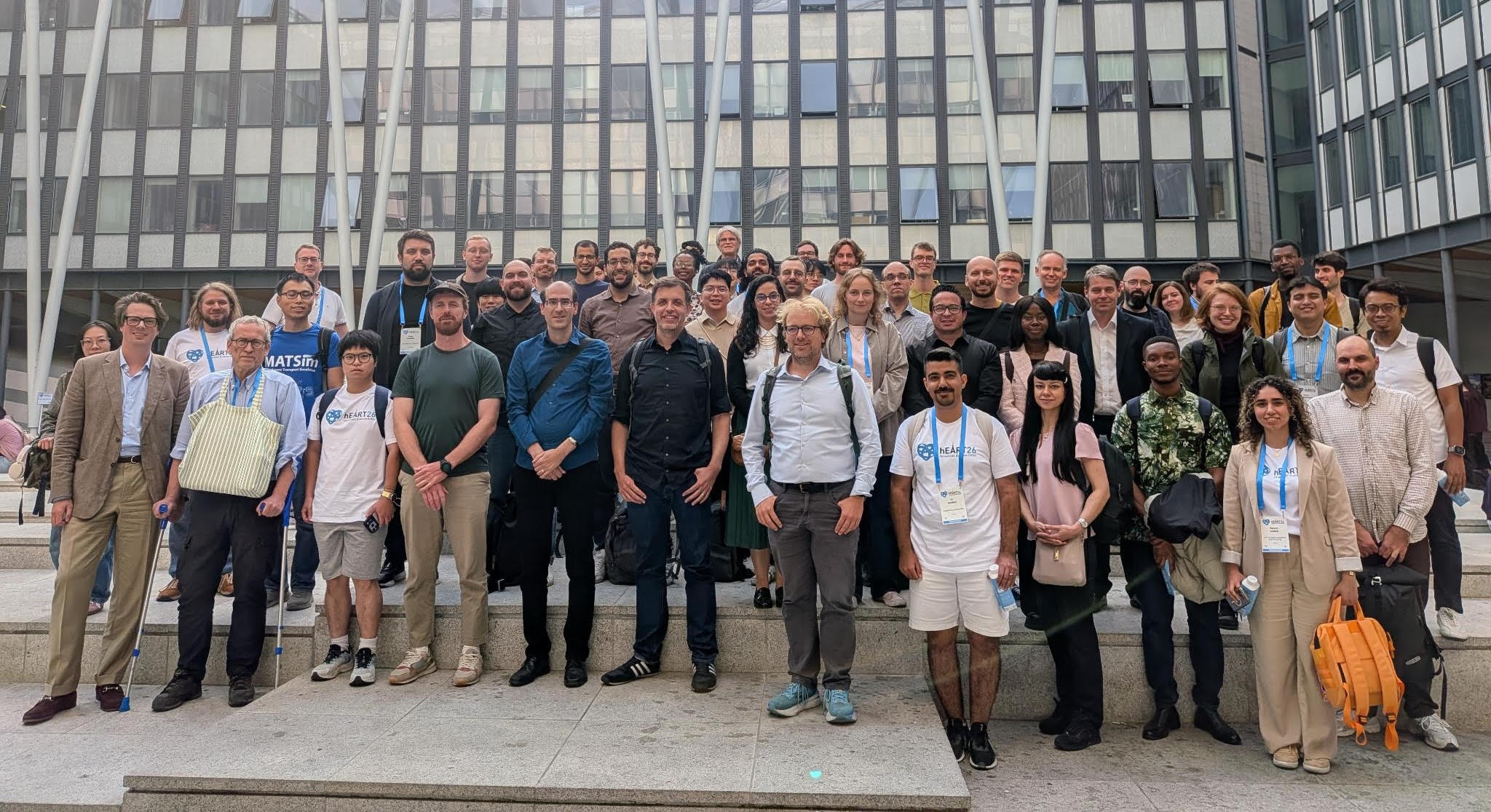
The MATSim Association held its User Meeting 2026 on Monday, 28 September 2026 at the CICSU, Pierre et Marie Curie campus of Sorbonne University in Paris, the day before the hEART 2026 conference. Forty-three presentations ran in two parallel tracks, Salle 105 and Salle 107, from 08:30 to 17:30, with four presenters joining remotely and about 75 participants in the rooms.
The MATSim Association Annual General Meeting was not held in Paris. Members will receive the invitation and agenda for a remote AGM later in the year.
Best Paper Award
The MUM2026 Best Paper Award goes to Nico Kuehnel (MOIA GmbH) for “Between driver and driverless: modelling remote operators for autonomous ride-pooling in MATSim”, with Lion Pfeil and Mark Frawley.
Presentations
The full timetable is on the program page. Slides are listed here in programme order by room and session.
Salle 105
Session 1 · Core engine and performance
Janek Laudan, Christian Rakow
DSim: A Distributed Mobsim, Ready to Use
( Abstract)
Paul Heinrich, Kai Nagel
A Deterministic Asynchronous Service-Based Architecture for Agent-Based Transport Simulation
( Abstract)
Joschka Bischoff, Annette Knupp
Scaling the Swiss National ABM: A High-Performance, Native Java Implementation for generating daily plans in MATSim
( Abstract)
Fadi El Eid, Sonja Fessler, Johannes Müller, Denissa Purba, Franz-Xaver Rupprecht, Gunnar Flötteröd
Simple MATSim replanning recipe
( Abstract)
Gunnar Flötteröd
New method and MATSim contrib for the Agent-based Traffic Assignment Problem (ATAP)
( Abstract)
Gregor Rybczak, Paul Heinrich, Kai Nagel
The search continues: Integrating parking into an agent-based transport simulation
( Abstract)
Session 2 · On-demand mobility and automation
Tom-Erik Kuhlen
MATSim in Production: Live Demand Prediction, Automated DRT Scenario Build and Visualisation for Non-Expert Users
( Abstract)
Sebastian Hörl
Benchmarking on-demand mobility algorithms using a new remote dispatching interface for MATSim
( Abstract)
Nico Kuehnel, Lion Pfeil, Mark Frawley
Between driver and driverless: modelling remote operators for autonomous ride-pooling in MATSim
( Abstract)
Laura C. Echeverri, Nicolas Coulombel
Autonomous Shuttle and BRT Integration: An Agent-Based Case Study of Paris's Southern Suburbs
( Abstract)
Jakob Rehmann, Lichen Luo, Kai Nagel
Introducing DRT and Person-Based Accessibility in MATSim
( Abstract)
Ziyue Song, Xinwei Wang, Lin Guan, John Woodward, George Vogiatzis
Accelerating MATSim-Based Vertiport Siting via Facility Location Surrogate Space Mapping
( Abstract) (remote)
Session 3 · Environment, health and resilience
Marjolaine Lannes, Nicolas Coulombel, Yelva Roustan
Modeling air pollution exposure with MATSim: to what extent are complex modeling chains necessary?
( Abstract)
Simon Metzler, Dominik Ziemke
A flexible and robust network generation pipeline for more detailed bicycle infrastructure representations in MATSim
( Abstract)
Peiling Wu, Fariya Sharmeen, Daniel Jonsson
Bikeability-integrated cycling policy evaluation, Eskilstuna (Sweden)
( Abstract)
Rodrigo Esteban Medina Godoy, Rosa Arroyo, Tomas Ruiz, Pau Seguí Gascó
How resilient is university mobility? Evaluating public transport disruptions with MATSim
( Abstract)
Chengqi Lu, Jyotirmaya Ijaradar, Regine Gerike
Synergy between aggregated anonymized real-world data and agent-based modeling: the Carola Bridge collapse in Dresden
( Abstract)
Session 4 · City-scale scenarios
Daniel Röder
Building the AgiMo Digital Twin: First steps towards continuous transport model assimilation
( Abstract)
Adnan Abir, Grace O. Kagho, Tasnia Tabassum Prima, Sk. Md. Mashrur
Towards a MATSim Scenario for a Data-Scarce Megacity: Dhaka, Bangladesh
( Abstract)
Anuj Nautiyal, Amit Agarwal
Beyond Carrying Capacity: An Agent-Based Model for the Char Dham Pilgrimage Corridor
( Abstract) (remote)
Azwan Nazamuddin, Reem Alolabi, Makoto Chikaraishi
A Reachability-Pruned Activity-Based Demand Model for MATSim: Congestion Response and Demand Generation in Higashi-Hiroshima
( Abstract)
Yaroslav Smirnov, Kai Nagel, Tina Rakic, Ricardo Ewert, Tim Volotskiy, Tilmann Schlenther
Agent-Based Modeling of a Zero-Emission Zone in Berlin Using MATSim
( Abstract)
Salle 107
Session 1 · Calibration and optimisation
Aurore Sallard, Milos Balac
Improving Public Transport Modeling in MATSim: Fare Pricing and Routing Parameter Optimization
( Abstract)
Maryam Samaei, Mahdi Zargayouna, Mélanie Gidel, Jonathan Couppé, Mostafa Ameli
A multi-source calibration framework for activity-based transport simulations integrating background traffic and travel-time perception
( Abstract)
Ashutosh, Sunhyung Yoo, Pieter Fourie, Vinayak Dixit, Divya Nair
A Crowdsourced-First Calibration Framework for Multi-Class MATSim Models in Data-Constrained Heterogeneous Traffic
( Abstract)
Abdelkader Dib, Milos Balac
Online Calibration of MATSim Models via Stochastic Batch Optimization
( Abstract)
Shahriar Iqbal Zame, Denissa Sari Darmawi Purba, Yusak Susilo, Constantinos Antoniou
Measuring perturbation-reconvergence cost in MATSim for charging-infrastructure placement
( Abstract) (not presented (presenter ill))
Jan Andrin Ghadamian, Orlando Roman, Milos Balac, Bryan Adey
An End-to-End Pipeline for Scenario-Based Transportation Modelling under Deep Uncertainty
( Abstract)
Session 2 · Demand generation, learning and tooling
Jingjun Li, Shiqi Sun, Francesco Ciari, Chengqi Lu, Guy Walker, John Easton, David Flynn, Philip Greening
Agent-based Simulation with Mobility Personas: An LLM-based Persona Labelling Approach for MATSim Synthetic Populations
( Abstract)
Fred Shone, Tim Hillel
Block box approaches to activity sequence modelling
( Abstract)
Ming Lu
Towards MAPPO and Inverse DRL for MATSim Replanning
( Abstract) (remote)
Jeramin Leong, Pieter Fourie, Apurva Kumar
CitySim: One Data Pipeline, Three Cities: Building MATSim Mobility Digital Twins for Pedestrian Safety, Flood Resilience, and Event Traffic Management
( Abstract)
Nadine Rieser, Moritz Dück, Marcel Rieser
Improved Automated Model Generation and Agent-Group specific Model Analysis
( Abstract)
Ihab Kaddoura, Tobias Kohl, Michael Balmer
MobilityStudio: Making MATSim Accessible - A Visual Workbench and a First Step Towards Conversational, AI-Assisted Transport Planning
( Abstract)
Session 3 · Public transport and rail
Ihab Kaddoura, Thomas Hettinger, Merlin Unterfinger, Nicolas Dulex
Using MATSim for strategic planning: Insights from various projects at Swiss Federal Railways
( Abstract)
David Kirkwood, Jingjun Li, Wenhua Jiang, John Easton, Heather Steele, Christian Rakow, Clive Roberts, Philip Greening, David Flynn
Integrating MATSim and Microscopic Railway Simulation for Passenger Transport Digital Twinning
( Abstract)
Theresa-Maria Mersini, Ibraheem O. Adeniran, Marcel Schindler, Alessandro Tarantola, Carina Kehrt
An Integrated Metaheuristic Approach for Generating Combined Road-Rail Transport Chains
( Abstract) (slides not published at the presenter's request)
Reza Abdullah, Anugrah Ilahi, Andria Arisal, Akimasa Fujiwara
MATSim for Jakarta MRT Expansion: Projected Ridership and Mode Shifts
( Abstract)
Timofey Volotskiy, Yaroslav Smirnov, Tina Rakic, Golan Ben Dor
From Activity-Based-Model to MATSim for BRT Planning: Practical Lessons from the Tel Aviv Pink Route
( Abstract)
Session 4 · Applications, visualisation and community
Noriel Christopher Tiglao, Niki Jon Tolentino
Modeling Informal Paratransit for Local Public Transport Route Planning: Tricycle-for-Hire Services in Puerto Princesa City, Philippines
( Abstract) (remote)
Sié Cyriac Noufe, Rachid Belaroussi, Francis Dupin, Pierre-Olivier Vandanjon
Multi-Agent Simulation and Crowdsourced Reviews for Urban Vitality Analysis: Insights from a Peri-Urban City
( Abstract)
Daniel Bell
A Pipeline for Visualising MATSim Events in Blender
( Abstract)
Marcel Rieser
Results from the MATSim User Survey
( Abstract)
Thanks
Our thanks to Latifa Oukhellou, Mostafa Ameli and the hEART 2026 organising committee for hosting the user meeting, to Maryam Samaei and Thomas Bapaume for running the two rooms on the day, and to everyone who presented.
Membership
MATSim Association membership supports MATSim core development, infrastructure and hosting, documentation and training, community coordination, and user meetings like this one. To support the association, visit the membership page.
Questions about the meeting can go to association@matsim.org.